

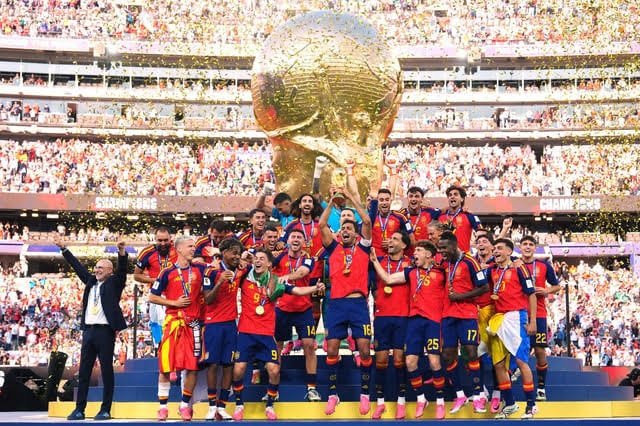
Spain’s World Cup champions came home to a hero’s welcome in Madrid. Relive the parade, the tears, the history, and the moment La Roja made football history.
Champions Return Home: Spain’s Unforgettable World Cup Celebration
Champions Return Home: Spain’s Unforgettable World Cup Celebration
There’s a particular kind of silence that falls over a country right before it erupts. Madrid felt it on Sunday night, in that half-second after the final whistle blew in East Rutherford, New Jersey, before the noise came crashing in. Spain had just beaten Argentina 1-0. Spain was, once again, world champion.
By the time the team’s plane touched down at home, the silence was a distant memory. What followed was one of those days a country doesn’t forget — the kind parents will tell their kids about years from now, pointing to old photos and saying, “I was there.”
A Homecoming Fit for Royalty
The players didn’t just land and go home to sleep off the adrenaline, even though most of them had barely slept at all. Instead, they climbed aboard an open-top bus with a simple message painted across its side: “Stars shine together.” Photos of the squad lined the vehicle as it rolled slowly out from Moncloa, the prime minister’s official residence, toward Cibeles Square — the same spot where Spanish football history has been celebrated for decades.
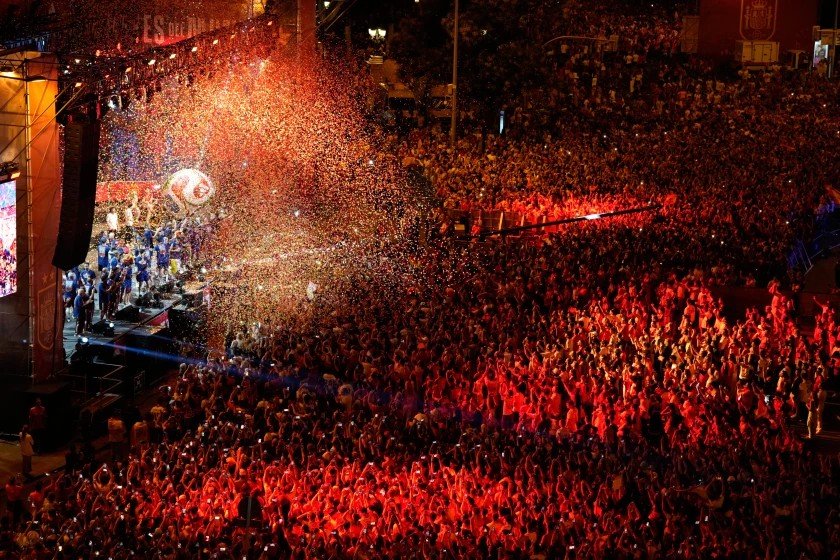
Crowds packed the route the entire way. Some estimates put the number of people who turned out across Madrid that day close to two million, with roughly 120,000 gathered at Cibeles Square itself for the closing ceremony. Flags waved from balconies. Horns blared from cars stuck in traffic that nobody seemed to mind being stuck in. It was the kind of scene that turns a city into one giant living room, everyone gathered around the same shared joy. <br>
(A photo-worthy moment: fans draped in red and yellow lining Gran Vía as the team bus rolled past — the kind of image that ends up on every front page the next morning.)
“It’s Two for Two”
Spanish Prime Minister Pedro Sánchez captured the moment perfectly with four simple words: “It’s two for two.” He wasn’t just talking about the scoreline. He was talking about something far bigger.
With this win, Spain became the first country in history to hold both the men’s and women’s World Cup titles at the same time. The women’s national team had already made history back in 2023, beating England 1-0 in Sydney to lift their first-ever World Cup. Now, three years later, the men had matched them. Two trophies, one nation, sitting side by side in the trophy cabinet.
For a country that spent decades being labeled underachievers on the biggest stage — despite producing some of the most gifted players and elegant football the world has ever seen — that kind of symmetry means something. It’s proof that Spain’s golden generation isn’t a one-off. It’s a system, a philosophy, and now, a legacy.
A Team Coach Luis de la Fuente Called “Emotional”
Head coach Luis de la Fuente didn’t try to hide how he felt before the parade even began. “It’s been an emotional and proud experience to represent a wonderful country with such passionate and devoted fans,” he said. “We are filled with joy.”
It’s easy to talk about tactics and formations when analyzing a World Cup run, but moments like this remind everyone why the sport matters in the first place. De la Fuente’s Spain played with a mix of patience and flair that frustrated bigger, more physical sides throughout the tournament, culminating in a tense, tightly fought final against a dethroned Argentina side that had been chasing back-to-back glory.
Only one country before Spain had ever managed to win it twice — Spain itself, back in 2010 in South Africa. Sixteen years later, they’ve done it again, this time on a different continent, against a different kind of pressure, with a completely new generation of players wearing the crest.
The Fans Who Waited Up All Night
Not everyone made it to Madrid’s city center, but that didn’t stop anyone from celebrating. Nineteen-year-old Víctor Álvarez put it simply the morning after: “I’m very happy. I’ve slept three or four hours, but for the team, I’ll do whatever it takes.”
Others chose a quieter kind of celebration. Gema Rodero, a 59-year-old civil servant, stayed home instead of heading to a bar. “We preferred not to go to any bar or anything, to experience it at home, focused and very happy, very joyful,” she said. It’s a small detail, but it says something about how deeply this moment reached — not just the young fans out in the streets until sunrise, but grandparents watching from their living rooms, feeling every bit as invested.
Champions Return Home: Spain’s Unforgettable World Cup Celebration
For many younger supporters, this was their very first time seeing the men’s team lift a World Cup trophy. An entire generation just experienced the kind of national delirium their parents talked about from 2010 — except this time, it was theirs.
A Reminder to Celebrate Safely
Amid all the joy, there was a heartbreaking reminder that celebrations, however joyous, need to be handled with care. Local authorities in Salamanca reported that a 13-year-old died after a fountain he had climbed onto with friends collapsed during the festivities. It’s a somber note in an otherwise triumphant story, and one that cast a shadow over the celebrations for many families following the news.
World Leaders Took Notice Too
Even beyond Spain’s borders, the achievement didn’t go unnoticed. Leaders from the tournament’s co-host nations — U.S. President Donald Trump, Mexican President Claudia Sheinbaum, and Canadian Prime Minister Mark Carney — sent their congratulations to the Spanish squad following the final. It’s a small but telling sign of just how far this victory traveled, resonating well beyond football circles.
Looking Ahead to 2030
If Sunday’s win felt like a storybook ending, there’s already a sequel on the horizon. Spain will co-host the 2030 World Cup alongside Portugal and Morocco, meaning the defending champions will get the rare and enviable chance to defend their crown on home soil. For a nation that just tasted the sweetest kind of victory, that’s a thrilling prospect to sit with for the next four years.
A Golden Era, Confirmed
Spanish football has always had its poets — players who make the game look less like a battle and more like a conversation, all triangles and patience and one-touch brilliance. What Sunday’s celebration confirmed is that this isn’t a fluke generation or a lucky run. It’s a golden era, backed up now by both a men’s and women’s world title within the same three-year window.
As the confetti settled over Cibeles Square and the last chants of “world champions” faded into the Madrid night, one thing was clear: this wasn’t just a party for a trophy. It was a celebration of everything Spanish football has built, brick by brick, tournament by tournament, to arrive at this exact, unforgettable moment.
And for the fans who stood in that crowd, or watched from home with tired eyes and full hearts, it’s a memory that will outlast the headlines — the kind you carry with you, long after the bus has rolled past and the streets have gone quiet again.
One thought on “Champions Return Home: Spain’s Unforgettable World Cup Celebration”
Comments are closed.